
At a Glance
Commercial door accessibility extends beyond wheelchair access and should consider the needs of all building users, including those with temporary mobility challenges, sensory impairments and people moving equipment. Choosing the right door system, incorporating appropriate accessibility features and maintaining reliable performance all contribute to safer, more accessible commercial entrances.
Contact Doorway Services today to discuss the right commercial door solution for your building.
Accessibility Is About Making Entrance Easier for Everyone
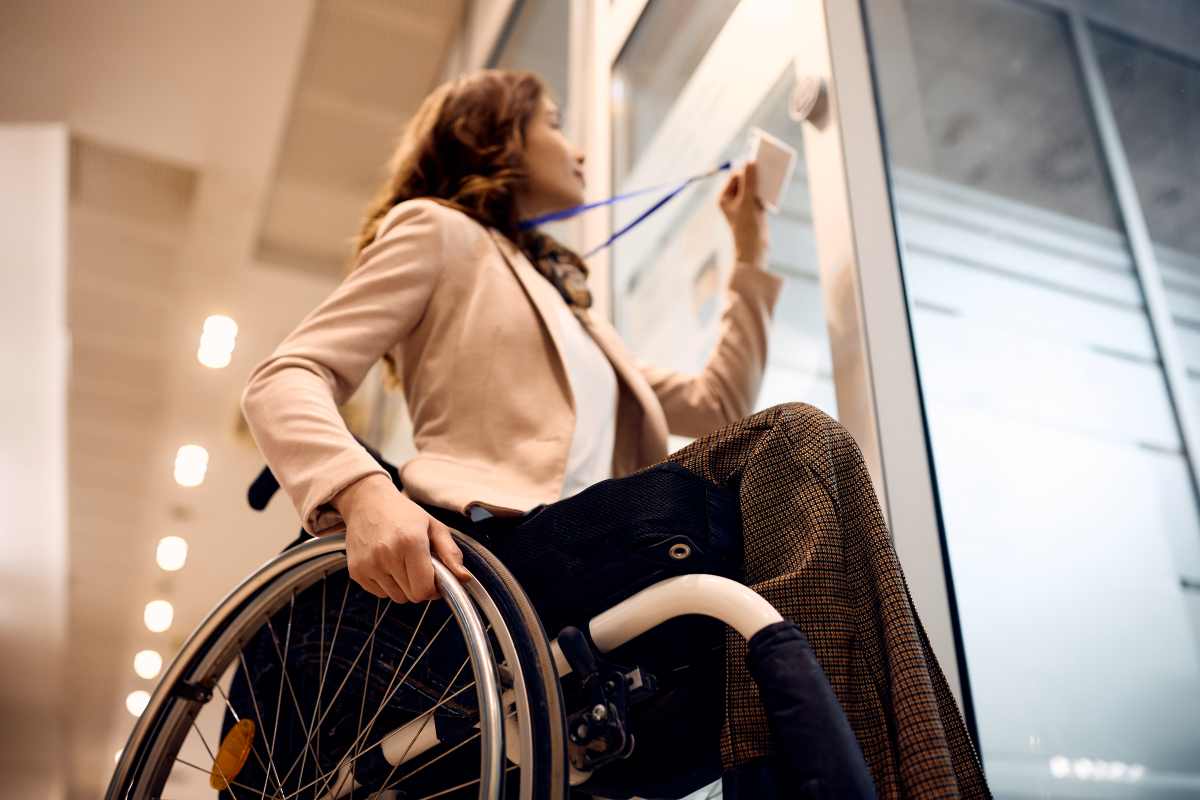
Accessibility is associated with wheelchair users, but commercial buildings serve a much wider range of people. Parents pushing prams, delivery drivers moving trolleys, visitors recovering from surgery, employees carrying equipment and older adults all rely on easy-to-use entrances.
This has become an important consideration for UK businesses. According to the Family Resources Survey, around 24% of working adults live with a disability, while many more experience temporary mobility challenges each year. Under the Equality Act 2010, organisations are expected to make reasonable adjustments that remove unnecessary barriers and provide fair access to buildings.
The entrance is one of the first places where accessibility is put to the test. A door that is difficult to open, slow to respond or unreliable in daily use can create frustration before someone has even stepped inside. On the other hand, a well-designed automatic entrance allows people to move through the building with confidence and minimal effort.
Improving commercial door accessibility is about meeting legal obligations, but there is more to it than that. It also creates a better experience for employees, visitors and customers while supporting the smooth operation of busy commercial premises. For organisations investing in new entrance systems or upgrading existing ones, accessibility should be considered from the very beginning.
How Commercial Doors Affect Different Types of Accessibility
Commercial door accessibility should support everyone using a building, not only those with permanent disabilities. Different users face different challenges and a thought-out entrance helps remove obstacles before they become everyday frustrations.
For some people, the biggest barrier is physical effort, because older adults, people with arthritis or anyone with reduced upper-body strength may find a heavy entrance door more challenging to operate. In such spaces, automatic doors eliminate the effort of pushing or pulling by opening on their own. Likewise, properly adjusted manual doors remain comfortable to use without compromising security or fire protection. However, the most suitable solution depends on how the building is used and the related accessibility requirements.
Accessibility also extends to people with temporary situations or mobility difficulties. For example, someone recovering from surgery, using crutches, pushing a buggy or transporting equipment through a building benefits from easy-to-navigate entrances. Features such as appropriate door widths, smooth operation and unobstructed access can make everyday movement simpler, regardless of whether the entrance is manual or automatic.
Commercial doors also play an important role for people with sensory impairments. Clear glazing, predictable door movement, visible ironmongery and reliable automatic activation where installed all help users understand how the entrance will behave. This creates a safer and more confident experience, particularly in unfamiliar buildings.
Finally, accessibility affects how people move through busy environments. Schools, hospitals, offices and public buildings usually experience high levels of pedestrian traffic throughout the day. Selecting the right combination of automatic doors, manual doors, fire doors and entrance hardware helps buildings manage the flow safely while supporting accessible entrance design and improving the experience for everyone using the building.
The Commercial Door Features That Have the Greatest Impact on Accessibility
Automatic Opening Systems
Automatic opening systems are one of the most effective accessibility features for commercial buildings because they allow people to enter independently without physically operating the door. This benefits wheelchair users, people carrying deliveries, parents with pushchairs and anyone whose mobility is temporarily restricted.
The right system depends on how the building is used, because automatic sliding doors are well suited to busy entrances with continuous pedestrian traffic, while automatic swing doors are a better choice for smaller entrances or internal access points. Selecting the appropriate system helps improve accessibility without disrupting the building’s daily operation.
Door Opening Force
Not every commercial entrance requires automation, but manual doors should still be easy to operate. Excessive opening force can make everyday access unnecessarily difficult and discourage independent use.
Door closers, hinges and hardware should be correctly adjusted to balance accessibility with security and fire safety requirements. Regular inspection helps maintain that balance and identify wear before it affects door performance.
Door Width and Clear Opening Space
Adequate door width is essential for safe and comfortable access. Wheelchairs, mobility scooters, hospital equipment, delivery trolleys and cleaning machinery all require sufficient clearance to pass through without obstruction.
The surrounding entrance should also remain free from unnecessary obstacles. Reception furniture, displays and poorly positioned barriers can reduce usable space, even when the doorway itself meets accessibility requirements. Considering the entire entrance rather than the door alone creates a more practical and welcoming environment.
Activation Devices and Sensor Positioning
Automatic doors should respond before users reach the entrance, allowing them to pass through naturally without slowing down or changing direction.
Correctly positioned sensors and activation devices are particularly important in hospitals, schools and commercial buildings where pedestrian movement varies throughout the day. Routine servicing helps maintain accurate sensor performance and ensures doors continue to operate safely as usage patterns change.
Opening and Closing Speeds
Door movements should feel natural and predictable, because when a door opens too slowly, it can interrupt pedestrian flow. At the same time, one that closes too quickly may leave users feeling rushed or unsafe.
Modern automatic door systems can be adjusted to suit the environment and the people using them. Regular servicing helps maintain these settings, ensuring the entrance continues to operate as intended throughout its service life.
Threshold Design
The threshold should allow smooth movement between indoor and outdoor areas without creating unnecessary trip hazards or obstacles for wheeled equipment.
Maintaining the threshold at a proper height improves commercial entrance accessibility and supports the overall performance of the entrance system. It is a simple design feature that has a noticeable impact on everyday usability.
Why Reliable Door Performance Is Just as Important as Door Design
A well-designed entrance only remains accessible if it continues to perform as intended. Automatic doors operate hundreds and sometimes thousands of times each day. Over time, normal wear can affect how smoothly they open, how accurately sensors respond and how reliably the system operates.
Similarly, small issues usually develop gradually, such as a sensor detecting movement less consistently, an operator falling out of adjustment or a door closer no longer performing as it should. While these faults may not stop the door from working altogether, they can reduce accessibility and affect the experience of everyone using the building.
Regular maintenance helps identify these problems before they become disruptive. Routine servicing keeps automatic doors operating reliably, supports compliance with relevant safety standards and can help extend the lifespan of the entire system. It also reduces the likelihood of unexpected breakdowns that could interrupt business operations or prevent people from accessing the building safely.
This is where working with an experienced commercial door specialist makes a difference. Doorway Services works with businesses across a wide range of sectors to deliver entrance systems that balance accessibility, safety and day-to-day performance. We also supply, install and maintain automatic sliding and swing door systems for various commercial environments, helping businesses choose solutions that suit how their buildings are used.
Keep Commercial Doors Accessible With Doorway Services
At Doorway Services, we provide planned maintenance, commercial door repairs and 24-hour emergency call-outs across Northamptonshire and the surrounding areas to help businesses keep their entrance systems operating safely and efficiently.
From automatic sliding and swing doors to manual, fire and steel doors, regular servicing helps identify wear early and keeps commercial entrances performing as intended. Whether you are installing a new commercial door system or maintaining an existing one, Doorway Services can help.
Get in touch with Doorway Services to discuss your commercial door requirements and find the right solution for your business, its users and your day-to-day operations.